
Updates from wrongfully convicted prisoners
Kevin Tower, Randall Raar, and Schaeffer Cox all have updates.

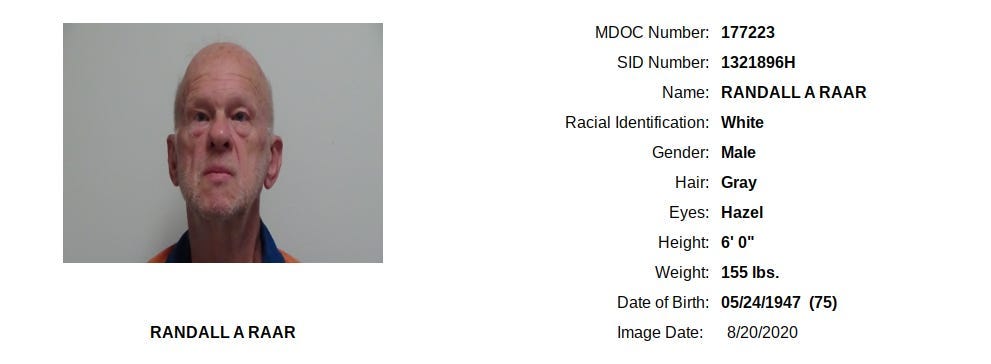
Two prisoners in Michigan prisons whose stories I have followed have reached out to me by email through JPay, and there is a happy update on another federal prisoner whose story I previously covered as well.
Schaeffer Cox
I first covered Schaeffer Cox, when I wrote about Marty Gottesfeld. Both Cox and Gottesfeld were prisoners in the notorious and euphemistically called Communications Management Unit (CMU) in Terre Haute, Indiana.
Two other inmates housed at the CMU have taken an interest in the killing, Marty Gottesfeld and Schaeffer Cox. Gottesfeld received a ten year sentence after he diverted traffic to the Boston Children’s Hospital in 2014, to protest their treatment of Justina Pelletier, a teenager many said was medically kidnapped by the hospital and Child Protective Services. Cox was a militia leader in Alaska, who was convicted of conspiracy to commit murder in 2012.
Gottesfeld and Cox wrote an article about the murder, and in an effort to publicize it, in August 2019, Gottesfeld filed a motion in his case in which the article was an exhibit.
Cox’s so-called conspiracy charge is incredibly convoluted, likely by design.
Cox, now 35, was a self-described sovereign citizen and leader of the Fairbanks-based Alaska Peacemakers Militia. Cox was charged in 2010 for failing to notify a police officer who contacted him that he was carrying a handgun. Federal prosecutors presented evidence in court that Cox hatched a plan called “241,” in which he and his fellow militia members would kidnap or kill two government or law enforcement officials for every one of the militia who might be arrested or killed.
In his appeal, Cox’s lawyers contended the solicitation conviction was unjust, as it was simply based on Cox at one point having brought armed and armored bodyguards to a radio appearance in North Pole. The three-judge appellate panel agreed.
Assistant U.S. Attorney Steven Skrocki said Wednesday the solicitation charge was a significant aspect of the trial, which went five weeks and included 80 witnesses and 1,000 pieces of evidence.
“That was certainly was one piece, but not by any stretch of the imagination the only piece. Certainly an agreement to murder individuals is something that our office of course, and the FBI took very seriously,” Skrocki said. “But on the other side, Mr. Cox still remains convicted of conspiracy to murder federal officials, so that’s also a very serious offense of course.”
Now, Cox is free, in a story I first noticed on Arthurina, run Jordan Bloom, who used to be my editor at The Daily Caller.
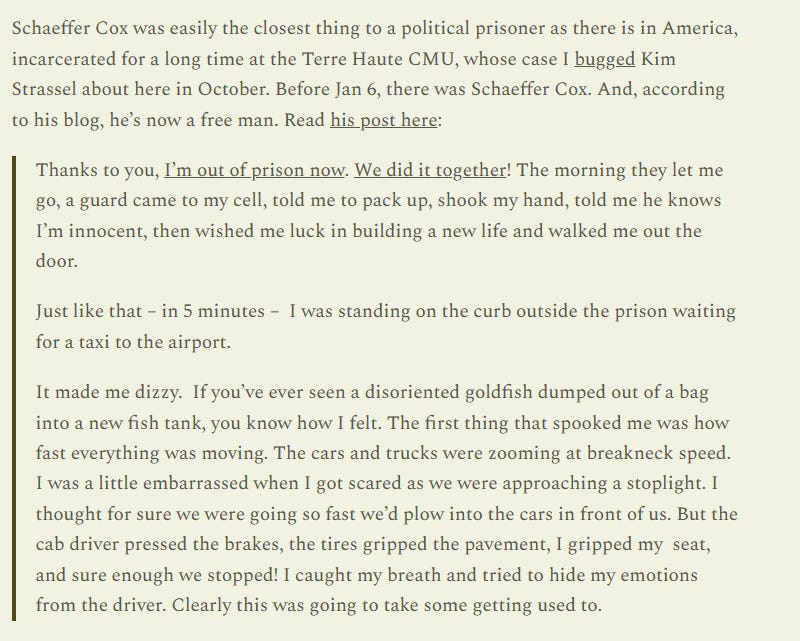
Find Schaeffer Cox’s full post here.
Kevin Tower
I first covered Kevin’s story in 2020. He was convicted of killing his two uncles, who died in July 1995.
Since the conviction, he developed an airtight alibi.
Beyond what is in the appeal, Tower said that in any new trial he would have an air-tight alibi.
Tower said he was watching movies with his sister during the evening July 5, 1995.
“I was fifty miles away,” Tower said, referring to his whereabouts at the time of the murder.
In fact, his sister testified at trial, but Tower thought the jury did not believe her since she was a family member.
At Tower’s trial, his uncles’ neighbor, Ronda Havens, testified she and her family heard gun shots on the evening of July 5, 1995.
“We were getting ready to set off fireworks at our house. And, when I pulled in the driveway, when I got out, I heard some gun shots. And my husband said, ‘go inside the house and see if anybody reports them’ because there was quite a few shots,” Havens said at Tower’s trial, referring to the evening of July 5, 1995.
In 2003, he tracked down receipts from the video store and submitted them for an appeal.
Tower provided copies of the receipts to me.
The receipts had him purchasing movies twice on July 5, 1995, once at 5:47PM and then at 10:22PM.
He said prosecutors then argued that the time of death could have been as late as July 19.
Morelli was able to track down the services of some of the best forensic pathologists to challenge that assertion.
She sent Tower’s file to Werner Spitz.
Spitz previously reviewed John F. Kennedy’s autopsy in 1975 for the House Select Committee on Assassinations.
He’s testified in the criminal trials of Phil Spector and Casey Anthony, along with O.J. Simpson’s civil trial.
In a letter, Spitz said that July 5, was the most likely day of death.
“In consideration of the ambient temperature, rain, etc., I estimate the post mortem interval (PMI) to be consistent with somewhere around three weeks, which would be in keeping with the period of when they went missing until their bodies were found,” Spitz said in a letter from September 21, 2015.
Another forensic pathologist, Timothy Huntington, did a forensic examination on October 9, 2015, and concluded, “Based upon the foregoing and a reasonable degree of scientific certainty, the estimated post mortal interval is 9 to 22 days, placing the estimated time of death between 5 July and 18 July 1995, with death of victims most likely occurring between July 5-7, 1995.”
Tower said he is confident that in a new trial between the forensic conclusions, his neighbors’ testimony of hearing a gun shot on the evening July 5, and his movie store receipt, he now has an air-tight alibi.
Key witnesses have said they were coerced.
That appeal argues that Cochrane, in an affidavit, recanted her testimony and stated prosecutors had secretly made a deal with her for a lighter sentence in exchange for testimony against Tower.
“In December of 1995, Mecosta County Chief Assistant Prosecutor John B. Sullivan visited me at the jail without my attorney being present. Prosecutor Sullivan convinced me that I would face a long prison sentence if I did not fully cooperate and fully cooperate meant me testifying favorably for the prosecution at Kevin Tower’s trial,” Cochrane said in an affidavit filed on April 1, 2016. “On the second day of my testimony, I was asked by Prosecutor Sullivan if I had a deal with the prosecution and I answered no. But I lied. I did have a deal and did receive promises from the prosecution.”
John Sullivan is now in private practice in Michigan and did not respond to a message left at his office.
The Mecosta County Prosecutor’s Office and the Mecosta County Sheriff’s Office did not respond to messages left at their offices.
Of testifying about seeing the knife, she stated in the affidavit, “The detectives and prosecutor told me I had to have known about the knife in Kevin’s truck and blood in the trunk of the car Kevin was driving. I was interrogated for two hours and they wouldn’t let up. I finally agreed to testify and said, ‘Fine, there was a knife in the truck.’ I was then bonded out of the jail on another conditional ‘PR’ bond.
PR stands for personal recognizance, or a bond with no cash.
Cochrane declined to comment further on her affidavit when reached through Facebook messenger.
Tower’s attorneys are arguing that this change in testimony amounts to new evidence, and they also argue that by withholding details of the plea deal the prosecution illegally withheld the terms of the deal.
“Rebecca Cochrane has admitted in a sworn Affidavit that she had an agreement to testify against Mr. Tower that was not disclosed to the defense.” Markou state in his most recent appeal. “This Affidavit contradicts the People’s response to trial counsel’s request for any plea deal or grant of immunity given to Ms. Cochrane.”
None of it is enough, and he remains in jail.
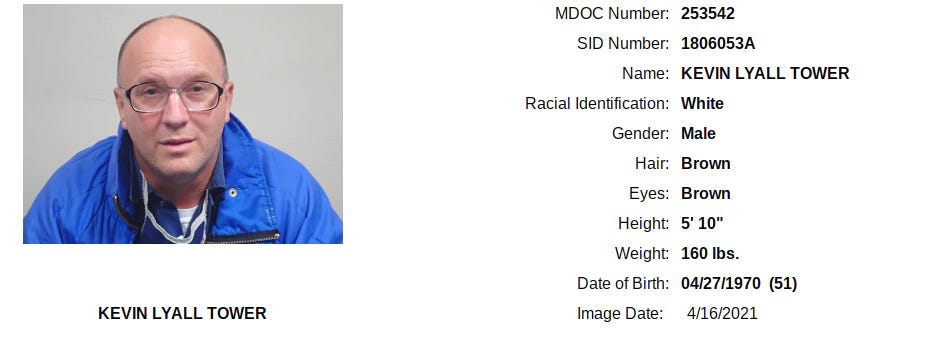
He recently shared some news which he believes may lead to a change in his case.
He has been diagnosed as autistic.
I was diagnosed with autism disability level 1, formerly termed Aspergers Syndrome. I am able to understand things well and can express myself at a high level. The problem is with the reception of verbal and visual information which is at a disabling level.
Generally, a jury would need to be informed that a defendant with murder charges has autism, as it may excuse intent. A person with autism may perceive a persons intent differently than reality, as they do not pick up all of the fine facial cues.
Secondly, a person with autism may not pick up on the nuances and vagueness of complex legal advice and may take things not intended to be literal, as literal. If an attorney is unaware that someone has autism, they could communicate legal advice to them ineffectively. In my case you have legal advice being provided, that was not received the same way.
Preliminarily, we have options to return to court, to file a claim that the jury needed to hear about the autism diagnosis. Also, I could not have made an intelligent and informed choice, as to plead guilty or proceed to trial. The original plea offer was for a twenty year minimum sentence that I have exceeded by over twelve years now.
We will continue to explore the legal options over the coming months.
I asked him how this might help his case.
Yes. There is a lot of work to do yet. I think the best approach is through marketing and mediation to open some minds up first.
Another option is to seek a change in the law. Because I now have the disability, attorneys and the court are obligated to honor the necessary accommodations, as the Americans With Disabilities Act (ADA) applies. Society sees this fair. Then, what occurred before, should be considered unfair and relief should be given to people who were convicted and sentenced before 2008 when the ADA expanded.
There is a road ahead of us and the attorneys will guide us.
He continued.
The diagnosis says that I can express myself well and have normal intelligence. However, I receive verbal information at a very low level. It has to do with my working memory. When someone like Lindy is talking to me and talks at any length, I miss most of the conversation. Even though my attorney was communicating information to me, I was not receiving it as it presented. I have trouble nuance and vagueness and can take things literal when they are not intended to be literal.
I am more conscious of this now, but I had no idea I had this disability at the time.
Yes. It could modify or reverse the verdict, or the sentence could be changed.
We are in the infancy of this right now and will get the best advice as things progress.
It would be different if the disability was known and accommodated for by the attorney and court.
Check out the interview that Lindy Morelli- mentioned above by Kevin- did on his case. Lindy comes on about thirty-five minutes in.
It’s hard to know if this will actually lead to a new trial, but here is what I found on the subject.
Although most with an ASD will not commit crimes, courts must understand how to handle requests to admit expert testimony in those cases where a criminal defendant shows signs and symptoms (or a diagnosis) of ASD. Because ASD often impacts not only the individual’s reasoning process in crime commission but also one’s ability to fully assist counsel in his/her offense in preparing a defense or navigating through the plea bargaining process, courts should not shy away from at least hearing testimony on the subject despite the fact that ASD symptoms (such as aggression) may resemble conduct of offenders not diagnosed with ASD (King & Murphy, 2014). As one advocate maintains, “[a] diagnosis of an autism spectrum disorder is as relevant to police and legal proceedings as a diagnosis of mental retardation or mental illness would be, no matter how bright, high-functioning, and/or verbal the individual may be” (Doyle, 2014).
Further complicating this is the fact that those diagnosed with ASD may respond in an inconsistent manner based on external factors such as emotions, familiarity with those around him/her, sensory pressures, and the situation at hand (Cohen, Dickerson & Forbes, 2014). However, courts are not uniformly receptive to expert testimony about ASD, special challenges that confront such individuals, and whether the disorder warrants the use of diminished capacity to relieve the actor of culpability or reduce the charge or sentence (King & Murphy, 2014). In short, it can be difficult to differentiate between conduct that is consistent with and characteristic ASD and conduct that is typical of an offender (Cohen, Dickerson & Forbes, 2014). What is clear from the literature is that courts should in the very least consider expert evidence regarding a defendant’s ASD diagnosis and how that related to the intent aspect of the crime.
For example, in State v. Burr, 2013 N.J. Super. Unpub. LEXIS 1130, at *1 (N.J. Super. Ct. App. Div. May 13, 2013), defendant was charged with second-degree aggravated assault and second-degree endangering the welfare of a child. He was convicted of second-degree aggravated assault and third-degree endangering a minor (State v. Burr, 2008). On appeal, the New Jersey Superior Court reversed the decision and remanded the case for a new trial on the basis that the trial court erred when it excluded defendant’s request to present expert testimony regarding his diagnosis with Asperger’s Disorder (State v. Burr, 2013).
In State of Western Australia v. Mack (2012), an autistic man was charged with murdering his mother. The trial judge gave little attention to the effect that his unusual and disruptive behavior had before the jury (State of Western Australia v. Mack, 2012). On appeal the court ruled that because jurors could have drawn negative impressions from the behavior, the case should have been tried before a judge alone. However, not all courts are sensitive to the use of expert testimony and mental health professionals in the criminal justice system. For example, in DPP v. HPW (2011), a man with ASD was accused of sexually molesting his 11 year-old daughter. The appellate court struck down the argument that the fact that the defendant misread his daughter’s sexual cues was caused by his ASD (DPP v. HPW, 2011).
Check out the short story Kevin wrote while in prison.
Randall Raar
Randall continues to serve out his sentence for child molestation in Michigan.
Randall’s story is troubling because he was convicted largely on the strength of testimony of his victim who was twenty-one when she testified but five or six when the crimes allegedly occurred. Here is part of an appeal.
The 59-year-old defendant was convicted of sexually assaulting his then five-year-old neighbor in the summer of 1989 or 1990. In April 2006, the police received information that caused them to investigate defendant and canvass his former neighborhoods. At that time, they had contact with the victim, who alleged that defendant had sexually assaulted her when she was four or five years old by digitally penetrating her vagina. At trial, the 21-year-old victim testified that defendant and his roommate, Robert Higgins, lived next door to her family’s home. Defendant and Higgins encouraged the neighborhood children to come to their home and use their above-ground pool. The victim indicated that she and her neighbor, AB, were among the children who spent time at defendant’s house. The victim explained that defendant and Higgins, both dressed in swimsuits, would be in the pool and catch the children as they came down an attached slide. The victim stated that defendant would “catch [them] between [their] legs and put his hands—or try to put his hands up [them].”
Randall’s latest missive is similar to many of his previous emails. It’s full of angst, frustration, and despair.
You are the ONLY person in this country that get my story out about how Michigan is gaining convictions in Criminal Sexual Conduct cases.
EIGHTEEN years, EIGHTEEN lawyers since 2006.
My lawyer FINALLY agreed to hook me up with an Polygrapher which is golden in a Motion for a new trial. He had an expert in Suggestibiity to finalize his review of all the files from 1990-1999 showing the woman in 2006 accused me of molesting her in 1988-1991.
It is obvious sex cases are not given the validity to show it never happened. I had a trial, lawyer and found guilty. NOT TRUE.
Once I get this Polygapher to show my inocence I will go all out to get it out but a simple Podcast won't do it. It needs a follow up with calls to the media outlets I am writing with your Podcast signature on YOU TUBE.
I will ot die with this stigma. It destroyd my 3rd marriage just like was done in 1990 when the same two families from 1990 wre alowed to return in 2007 and change the stroy.
Stay healthy. My mental stage deterioting.
I feel like I am in Goza and can't get out.
He continued in a subsequent email.
I am seriously in a state of dispare {sic}. I do NOT trust lawyers. DELAY DELAY. We and a hearing 1/13/2023 concerning the Pension fundng. My wife was at the First hearing 11/10/22 with my first lawyer John Shea from 2006 and in the hearing 1/13 the Judge said she is entitled to 50% of the pensions. Shea never objected in any motion afterwards.
This is the story. Lawyer complicity in Michigan.
Found another lawyer for $10,000 to colloborate with my present lawyer, who has dragged this out for 2.6 years. Then present lawyer said he would finally obtain a Polygapher. But NO P.I.
I am attempting to find you funds b/c the media outlets I wrote need to be called to see if they will respond to my letters.
Where does anyone go to expose how corrupt the criminal justice system really is? US DOJ (no response). FBI (no reponses). State colluding. Once a CSC convicted, he is doomed. No DNA, doomed.
I am preparing my Will. Wish I knew you better, I have NO Executor and do not know where to park it. Was Notorized 12/7/2023.
I appreciate your existence. This is a national storyline. NOBODY dares touch this. Media believes everyone who is charged with a sex crime is guilty, plead or trial. Mine was a scam trial.
Randall explained more about the state taking his pension here.
Postscript
Check out the previous free articles in this series. Find the first, second , third , fourth, fifth, sixth, seventh, and eighth article, and ninth article.
Check out the fundraiser on wrongful convictions.