

In Courtney Clifford’s case, San Diego, California, Judge Renee Stackhouse has flagrantly violated Piqui’s Law.
Jen Pedersen joined me to talk about how Judge Stackhouse violated another law- FC 3044- in her case.
FC 3044 was designed to keep domestic abusers from getting sole or joint custody.
Upon a finding by the court that a party seeking custody of a child has perpetrated domestic violence within the previous five years against the other party seeking custody of the child, or against the child or the child’s siblings, or against a person in subparagraph (A) of paragraph (2) of subdivision (a) of Section 3011 with whom the party has a relationship, there is a rebuttable presumption that an award of sole or joint physical or legal custody of a child to a person who has perpetrated domestic violence is detrimental to the best interest of the child, pursuant to Section 3011 and 3020. This presumption may only be rebutted by a preponderance of the evidence.
FC 3044 created a rebuttable presumption against someone with a domestic violence finding getting joint or sole custody. That domestic violence finding doesn’t have to be against the children in dispute.
According to FC 3044, if a judge feels the circumstances overcome that rebuttable presumption, that judge is required to address seven factors including steps the domestic abuser is taking to get treatment.
Back in January 2026, Jen got a domestic violence restraining order (DVRO) against her ex-husband, Lane Pedersen.
Lane Pedersen is represented by attorney Michael Fischer, who did not respond to an email for comment. A voicemail left with Judge Stackhouse’s chambers was not returned.
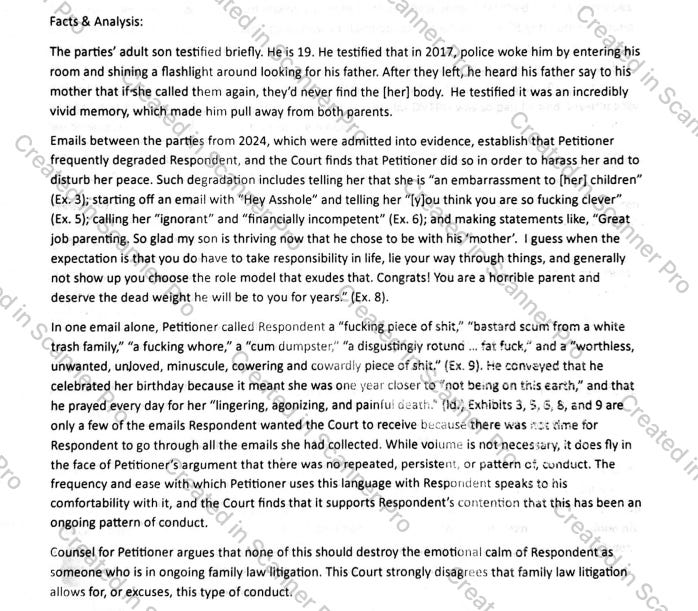
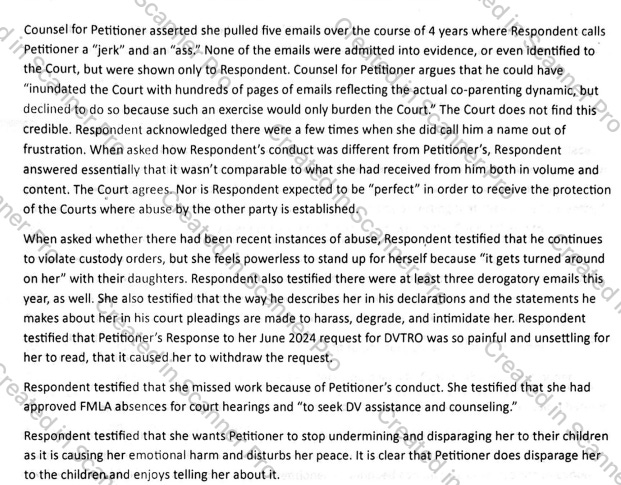
In the DVRO hearing, their adult son testifying that after she called police in 2017, Lane said that if she called them again, “they’d never find her body.”
She presented text messages and emails of him calling her a “jerk” and an “ass.” Lane also disparaged her to their two underage kids.
That last part was especially important because since 2024 Lane took custody of one of their girls.
Jen told me that one day he refused to return her. She tried for months to file the right motion to get her back but because she was pro se, she was repeatedly rejected.
She said that several months after Lane refused to bring her daughter back, she finally got in front of a different judge, Victor Torres.
Judge Torres ruled that the girl refused to go back, and he wasn’t going to force her.

Jen said that Judge Torres was filling in that day for Judge Stackhouse.
Armed with her DVRO, Jen went back in front of Judge Stackhouse months later. Judge Stackhouse paid lip service to FC 3044 but argued that the rebuttable presumption was met.
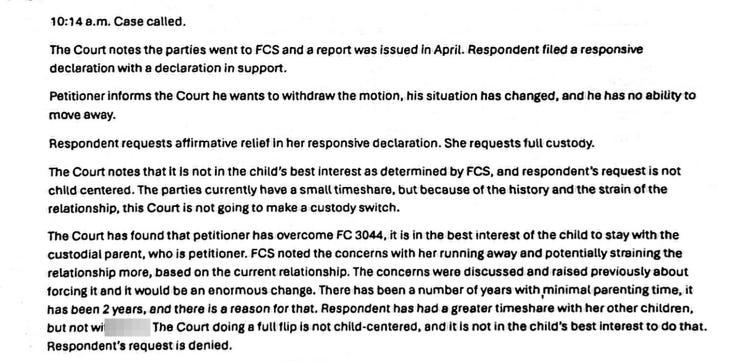
“The court has found that petitioner has overcome FC 3044. It is in the best interest of the child to stay with the custodial parent, who is petitioner.” Judge Stackhouse said in her order.
Judge Stackhouse referred to her daughter threatening to run away, something Jen said she could not find in any court document.
More importantly, Judge Stackhouse issued a minute order, which is a “quick legal order or judgment given by a court in answer to a party’s motion,” according to Boyd Law.
A boilerplate minute order doesn’t suffice when a judge determines that the rebuttable presumption has been met. That’s because the judge has to address numerous issues before stating that the rebuttable presumption has been met.
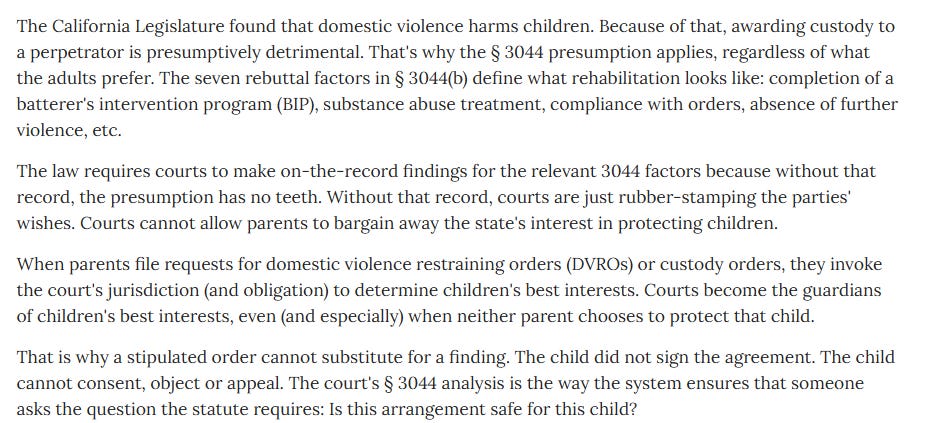
In her order, Judge Stackhouse met almost none of the requirements of FC 3044. Jen explained further.
“I cited that he hadn’t started his anger management class. He owned guns during the entire proceeding of the restraining order. He had two workplace restraining orders granted against him. He violated our restraining order at least 10 times. The list goes on. So, I - I included all these things in my motion…And she just was ready to hit her gavel and say, ‘okay, let’s move on.’” Jen told me.
There is also a revealing dichotomy in the two Stackhouse cases I covered- Courtney Clifford and Jen Pedersen.
In Courtney’s case, Judge Stackhouse is determined to reunite children with a father they vociferously resist.
In Jen’s case, Judge Stackhouse cited the child’s resistance as a reason not to switch custody.
The only connecting element is that she targeted women in both cases. I explained further.
The dichotomy may be explained by Judge Stackhouse’s childhood.
“My mother had her own stuff to deal with, and when I was 2, she brought me to Grandma’s and I never left. I would see her every once in a while growing up, but I haven’t talked to her since I was 18.” Judge Stackhouse told The Daily Journal.
I have spoken with several women who would not go on the record but told me they were also victimized by Judge Stackhouse.
This is not proof of an anti-female bias, but anecdotal.
Furthermore, in one hearing I listened to, she ruled against a man who fervently argued that his ex was filing false allegations in a serial manner.
Still, her past raises doubts about her objectivity when deciding custody cases. Her orders should be scrutinized to determine bias.


