

If you’re located in the Boston area, you may have the impression that Alan Davidson and his company, Chestnut Hill Estate Sales, does shady business.
That impression comes from two Fox 25 stories produced by local reporter, Amal Elhelw.

Ms. Elhelw did not respond to an email for comment.
The first was produced in November 2025 and interviewed four unhappy customers from his company. One, Marti Naddaff, described her story below.
When victims tried to get answers, they claim Davidson stopped answering entirely. That’s when Marti Naddaff started tracking other sales and would show up to confront Davidson.
“It seemed that he had a watchdog who saw us coming, and as we were coming in the front door of each sale, Alan was heading out the back door,” Naddaff remembered.
In 2019, Naddaff was moving out of her 22-room home of 40 years. She hired Davidson, who she said brought in outside jewelry the day of the sale.
“This house was probably one of the finest homes in Newton,” Naddaff explained. “It suggests that this jewelry is very valuable. Come to find out a lot of it was knockoffs, and I’ve read in subsequent reviews and heard from people that that’s what he does.”
Naddaff did end up getting an accounting of what Davidson claimed was sold, which came out to a $32,000 take-home.
“We got what was supposed to be a final payment, and that check did not clear at the bank,” Naddaff said.
Naddaff and her husband tried to track Davidson down for months, but in the midst of a major life change, they accepted that the $32,000 was gone.
“You don’t have the bandwidth at that point. You’re focused in a whole other direction. I really think he counts on that, took advantage of that, knows that’s where a lot of people would be,” Naddaff said.
In the story, Elhelw claimed that she reached out to Alan but never heard back; he remembered it differently when he spoke with me. He said he only agreed to an interview done live, so it couldn’t be edited.
Because he didn’t contribute to the story, he never had a chance to respond until our interview. That portion is below.
“I’ve done nine hundred estate sales,” Alan told me, “Maybe, ten complaints, maybe.”
He told me that Ms. Naddaff was paid, though there was a problem with the first check. He said that he subsequently wrote her two checks, and she never approached him with a problem.
The first he heard she had complaints was in the news story.
It was the events surrounding the court appearance on February 19, 2026, which raise serious eyebrows.
On February 16, 2026, a Sheriff’s Deputy with the Norfolk County Sheriff’s Department sent Alan a text message directing him to come to the Dedham District Court on February 19, 2026.
Alan told me that prior to this, he knew nothing of a small claims suit. Since 2025, according to Massachusetts court records, Ed Burnim had pursued a small claims claim against Alan for just over $7,000.
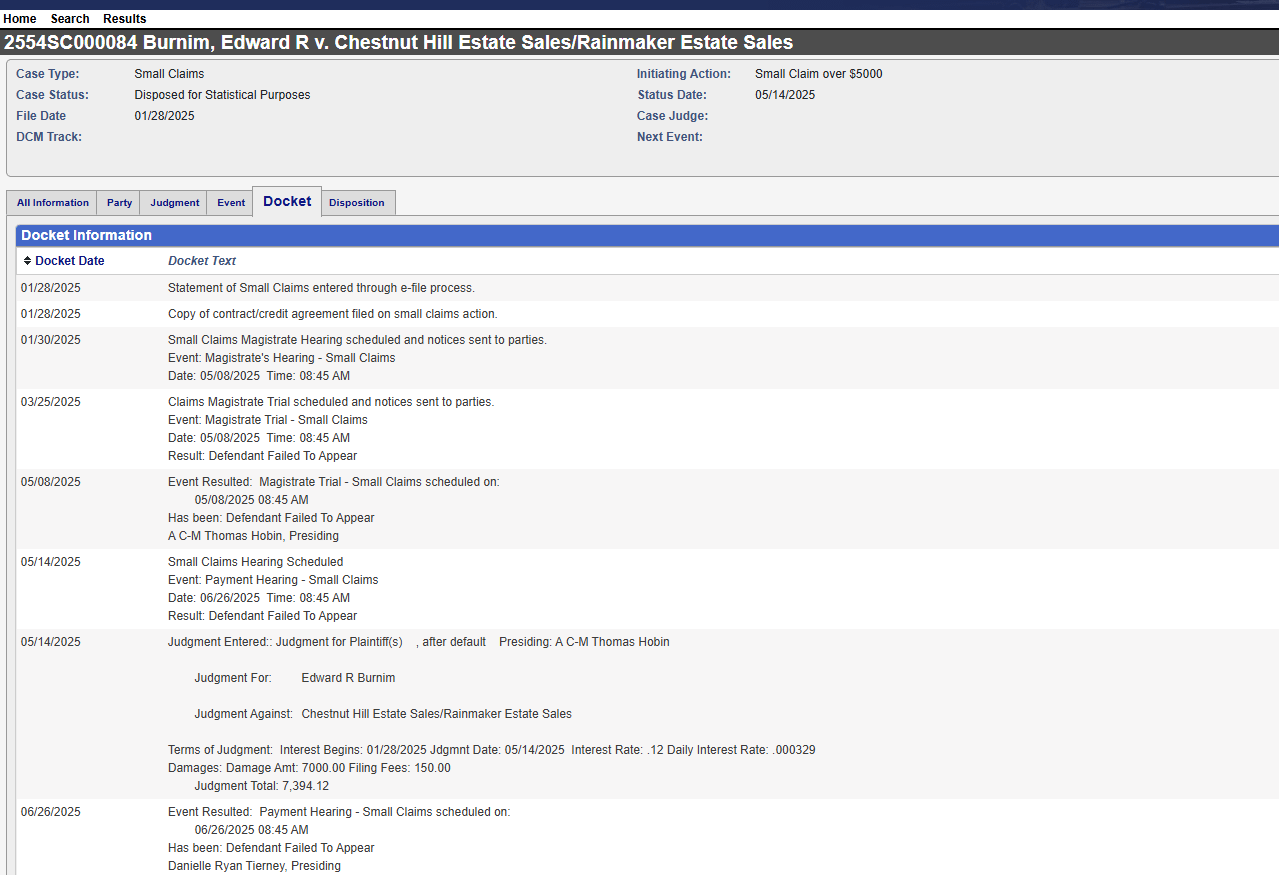
A phone number listed for Burnim was no longer active.
Of note, the suit was brought against Alan’s company, not Alan.
Alan said he came to the courthouse on February 19 and saw Elhelw and her crew getting out of their car.
“I asked her why she was there, and she told me she was here for me,” Alan told me.
He found this curious since this was a small claims matter.
He entered the courtroom and right before court he filled out a financial form.
Elhelw described what happened next in her news story.
Mr. Burnim told the judge that Alan owned four and not two cars, according to a private investigator he hired.
The judge quizzed Alan, who said he owned two cars and leased two cars.
The judge, Magistrate Chris Cawley, said Alan was “not credible” and sent him to jail.
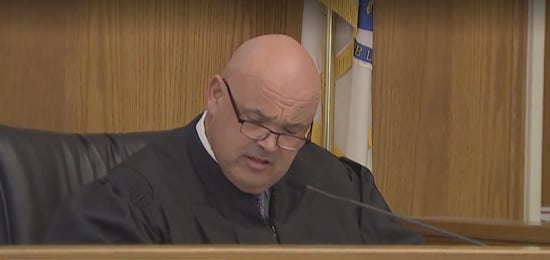
Alan was confused and said that he thought he was in court to make a payment plan. Alan then described what happened after the cameras stopped rolling.
Alan said he was taken into custody, not given his prescription medication, not allowed to make a phone call, and told to get out he’d have to pay $7,000, or he’d stay in jail for thirty days.
He said a nice Sheriff’s Deputy called a family member who delivered a check. He got out hours after being taken into custody.
“Is it fair to say they dreamed up a scheme to put you in jail just to get you to pay them money you supposedly owed?” I asked rhetorically.
To answer that, I went to Michelle MacDonald: I have interviewed Michelle many times about the Rucki case and more.
She’s practiced law over three decades, and she was previously a small claims judge, like Magistrate Cawley.
She said that simply having a judgment, like Mr. Burnim did, was only the beginning of the collection process. She described it in detail below.
“Once somebody gets a judgement. In small claims court, I issued many judgments. In small claims they have a whole other process for collection.”
The judgment has to be attached to something, preferably a bank account and that begins the process of collection.
Michelle also noted that before any of that, the subject of the judgment must be noticed, or served.
None of that happened here. Alan was never served with complaint or the judgment. Instead, a sheriff’s deputy told him to come to court.
Furthermore, Michelle noted that the judgment was against Alan’s company, not Alan.
That would have made it even more difficult to collect.
It was easier to dream up a scenario, throw Alan into jail, and order him to pay to get out.
“It was debtor’s prison in its purest form,” she told me.
Alan said there was one more thing which was also shady.
He filed an open records request for documentation related to his detainment.
A lawyer responded by saying they had no record.
I am writing in response to the below request. We have no records responsive.
Please be advised, the Norfolk County Sheriff’s Office is a jail and house of correction that houses male offenders awaiting trial or serving a sentence of 2.5 years or less. We are not an arresting/police authority or a court. Any information regarding arrests, police reports, police record checks, traffic violations, etc. would have to be requested directly to the city/town police department(s). Additionally, any information relative to court proceedings, possible charges on file, dispositions, etc. would have to be obtained from such court.
The attorney provided no further guidance.
I filed an open records request with the same department, but that has not yet been fulfilled.
Finally, Alan never had a chance to answer Mr. Burnim’s charges. In his complaint, he made the allegation below.
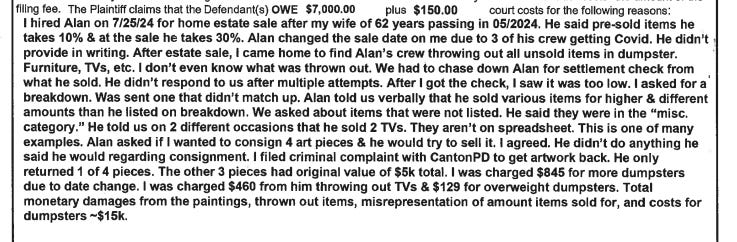
Below is Alan’s response.
He said he sold three paintings for less than $200 each, which Mr. Burnim got paid for. He returned an expensive unsold painting. He said that Mr. Burnim got paid, with a full accounting. He also said that he was contracted to clean out the house of unsold items, and Mr. Burnim was there when the dumpsters and when things were thrown into the dumpster.
“When you do an estate sale, a lot of people expect to get a lot more money for their items,” Alan told me.


