

An unscrupulous California attorney is finally facing the wrath of the California bar, and his response to allegations of repeated frivolous filings were jaw dropping.
In March 2023, Justin Beck joined me on the podcast to talk about his experiences with Orange County attorney, Ken Catanzarite.

Justin was back to talk about another Catanzarite case he was tracking.
Catanzarite represented plaintiffs in a dispute involving a California corporation, PLANTATIONS AT HAYWOOD 1, LLC.
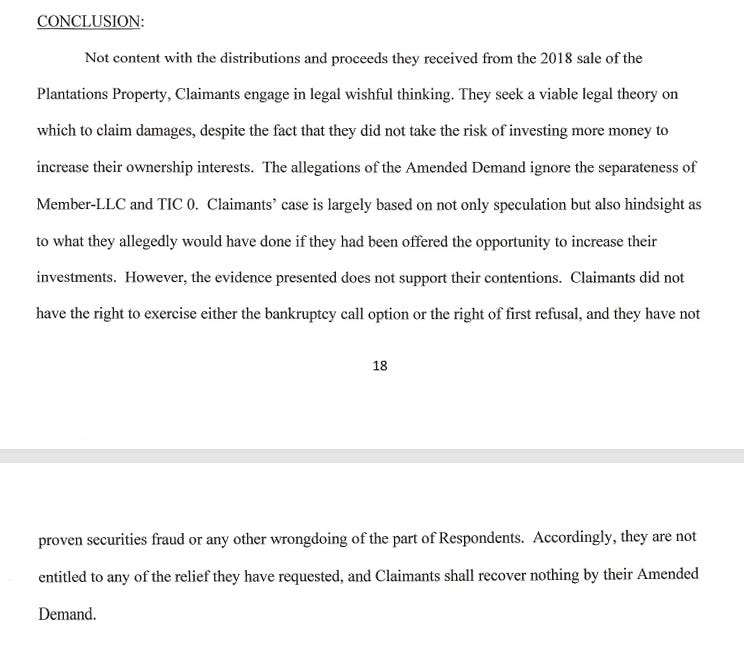
Both parties agreed to arbitration and the arbitrator slapped down his clients. Below is part of the conclusion.
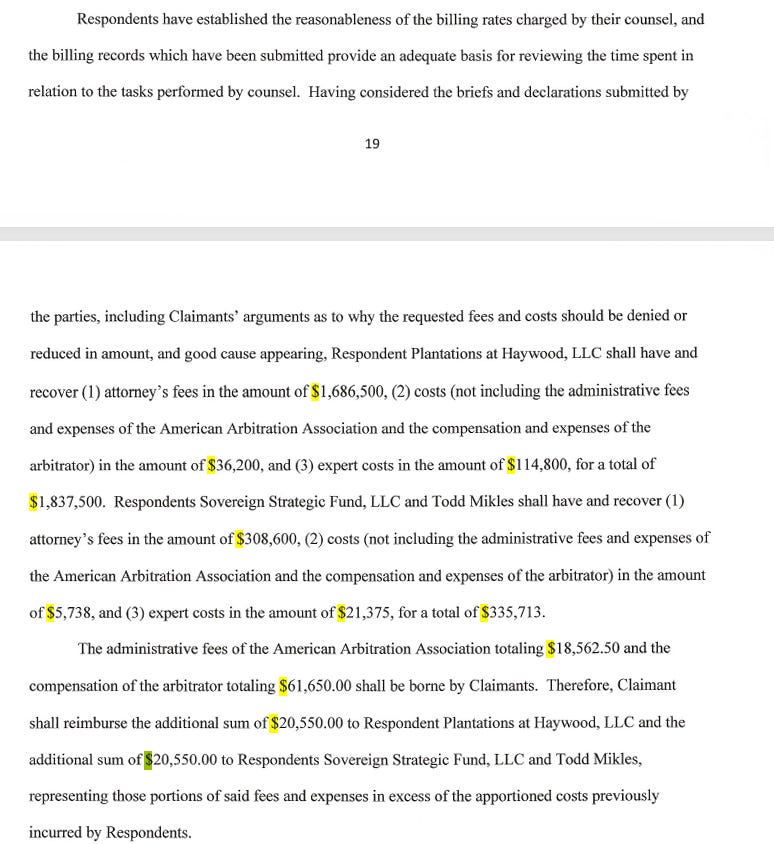
The arbitrator awarded the other party millions in legal fees.
Unhappy with the outcome, Catanzarite applied the arbitrator’s ruling.
Only, the law limits significantly what can be appealed in arbitration. Short of fraud, bribery, and other illegal activities, an arbitrator’s ruling is final.
Catanzarite wasn’t arguing any of that. Instead, he claimed that his evidence was so strong the arbitrator must have ignored his presentation.
He first went to a trial court and then to the California Court of Appeals.
The California Court of Appeals in the 4th District was having none of it. They issued an opinion which stated in part.
Catanzarite’s supporting declaration stated, “[a]lthough the Arbitrator ostensibly admitted all or nearly all exhibits ‘into evidence’, (emphasis mine) this was done only as a pretext to allow the Arbitrator to willfully refuse to hear dispositive evidence. All exhibits attached hereto were exhibits ostensibly ‘admitted’ in the Arbitration.”
Catanzarite cited no evidence in his briefing or at oral argument to support his claim, i.e., no admissions, statements, or rulings by the arbitrator that suggested any refusal on the arbitrator’s part to consider the evidence offered by plaintiffs.
Instead, Catanzarite’s argument was that because his documents had “plainly show[ed]” facts that were inconsistent with the arbitrator’s award, the arbitrator must have ignored plaintiffs’ documents. In other words, since Catanzarite disagreed with the award, the arbitrator must have willfully ignored his clients’ evidence.
The California Appeal’s Court concluded that his appeal was frivolous.
Catanzarite also asserts that contrary to the trial court’s finding, his opposition was supported by substantial evidence. We disagree. Catanzarite’s argument was that “[a]lthough the Arbitrator ostensibly admitted all or nearly all exhibits ‘into evidence’, this was done only as a pretext to allow the Arbitrator to willfully refuse to hear dispositive evidence.”
As discussed above, Catanzarite offered no evidence to support this assertion of overt arbitrator misconduct. His evidence demonstrated only that he had submitted documents to the arbitrator which, when viewed in the abstract and most favorably to his clients, were arguably inconsistent with some aspects of the arbitrator’s award. As Catanzarite’s own proffered authority states, even if such inconsistency were sufficient to suggest arbitrator error, it would not be sufficient to demonstrate intentional misconduct. (See Burlage, supra, 178 Cal.App.4th at p. 531, 100 Cal.Rptr.3d 531.) Because Catanzarite failed to offer any affirmative evidence in support of his contention that the arbitrator admitted his evidence as a pretext for refusing to consider it, we find no error in the trial court’s determination that Catanzarite failed to produce sufficient evidence to support a finding in his favor.
The affair caught the attention of the California bar. The California bar is struggling with a credibility crisis after revelations borne out of the prosecution of Tom Girardi. Before he was convicted of wire fraud and other charges on August 27, 2024, Girardi spent years bribing California bar officials with gifts, cash, and other valuables to look the other way at his malfeasance.
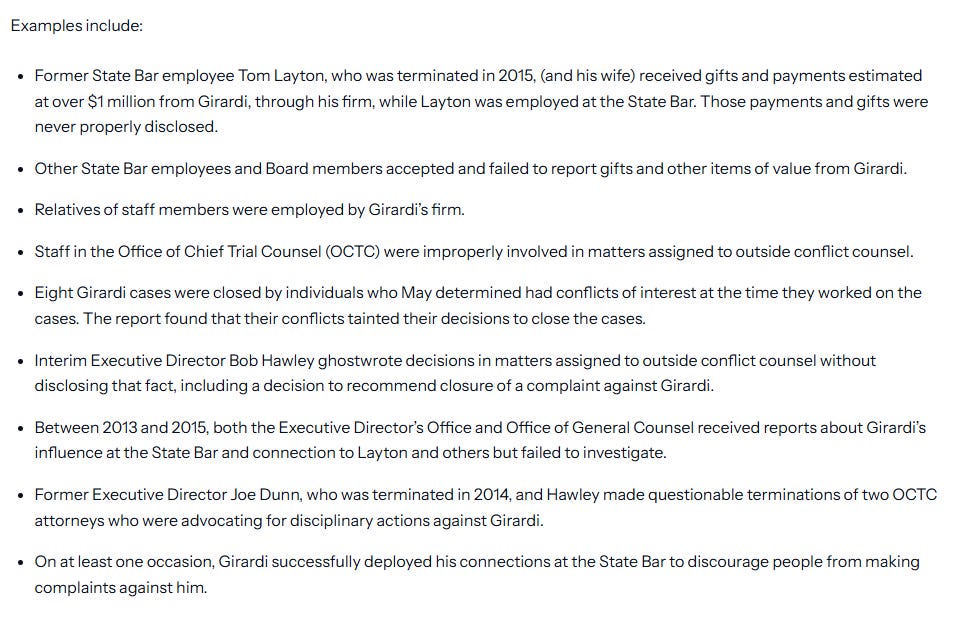
Justin previously filed a complaint against Catanzarite which went nowhere. In conversations with bar investigators, he was offered excuses for why Catanzarite previously skated. Part of the interview is below.
“In fact, it’s the party that’s prosecuting him. And what he said was, is that they would get buried in paperwork. So, it’s almost as if the very conduct that he’s, you know, accused of and shown to engage in by courts. This isn’t speculation- is what has kept him from getting in trouble so long is that you have like a decade in some instances of this crazy sprawl of cases and the state bar is just like, ugh. We can’t even begin to, you know, unpack this.” Justin told me.
In this case, the California bar filed a two-count complaint, accusing Catanzarite of filing numerous frivolous filings.
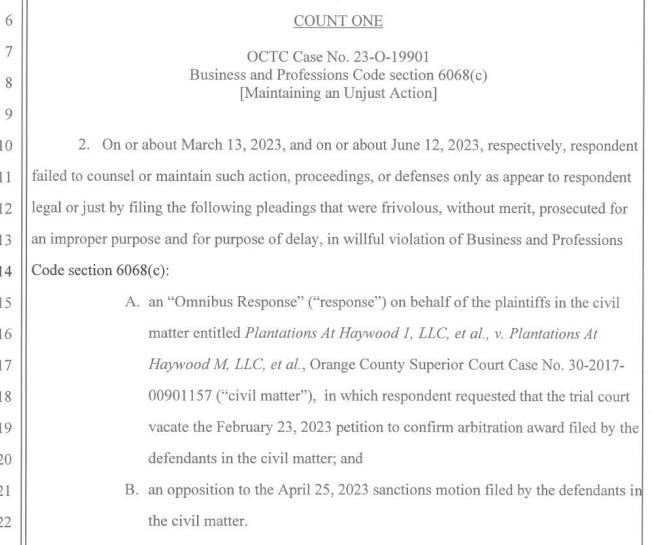
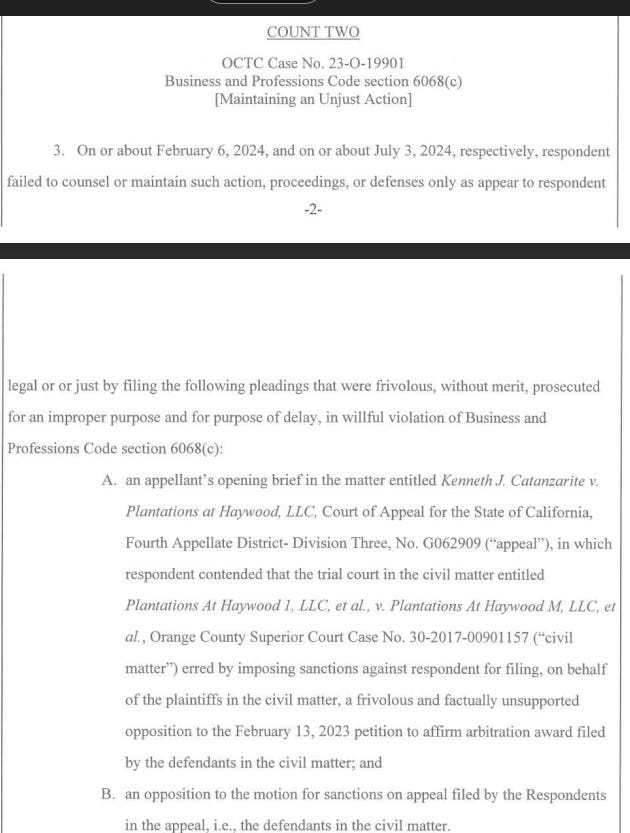
Catanzarite, rather than defending himself, argued that he shouldn’t be held responsible for his ethical lapses because he’s a narcissist and had an episode. Below is part of the bar’s response to his defense.
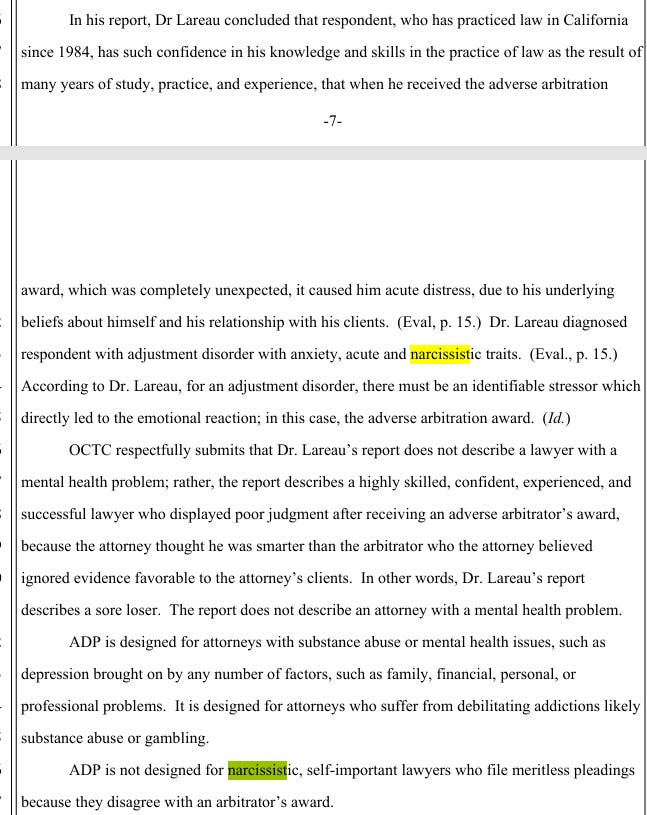
Catanzarite argued that he should be put into the Alternative Discipline Program (ADP), a program for lawyers with mental health or substance abuse issues.
The bar rejected this argument, “ADP is not designed for narcissistic, self-important lawyers who file meritless pleadings because they disagree with an arbitrator’s award.”
Catanzarite was represented against the bar by Erin Joyce. Neither Joyce nor Catanzarite responded to emails for comment.
Though Catanzarite has flown under the bar radar, this is not his first run in with bar discipline. The California bar provided me with another discipline action from the 1990s. This action shows another pattern with Catanzarite. He represents parties on all sides of a dispute; despite the conflicts those representations create.
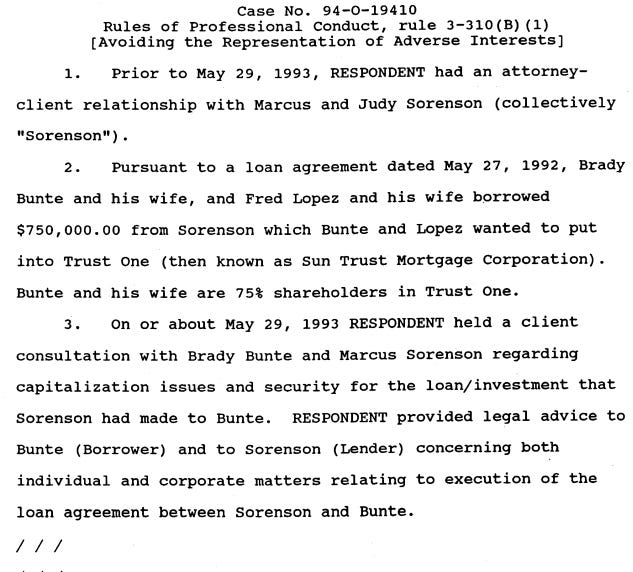
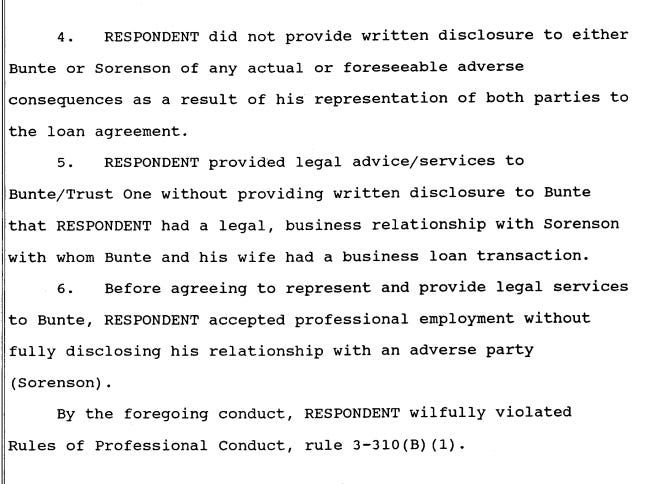
In Justin’s case, Catanzarite also represented all sides of a dispute, while destroying a multi-million-dollar company he was building. At the time, it had strong growth, tens of millions in seed funding from a publicly traded company, and thirty employees.
All of that was wiped away after protracted litigation from Catanzarite.
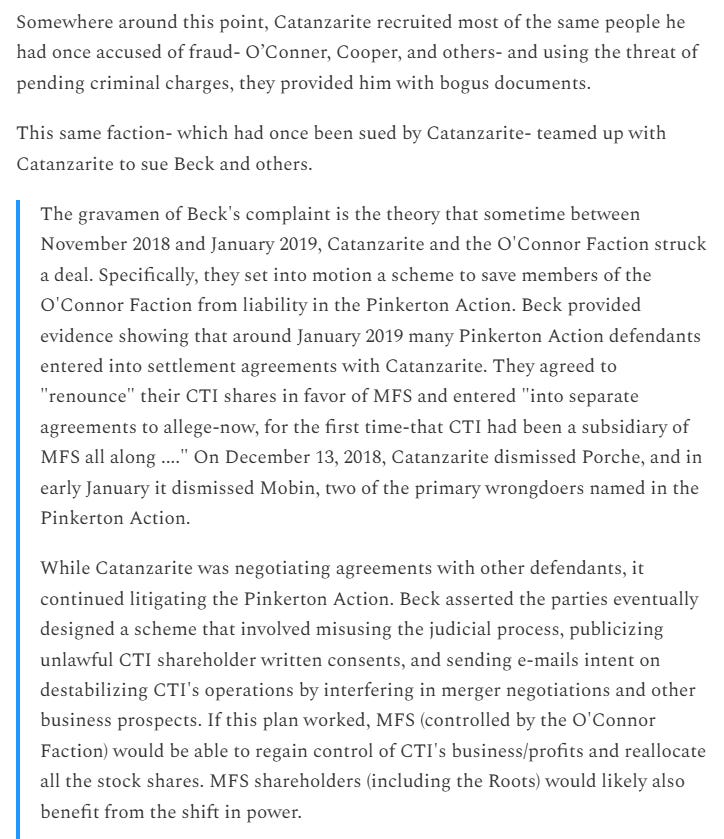
Justin told me that a quirk in the law makes it difficult to challenge these blatant conflicts.
Justin described Catanzarite’s Modus Operandi.
My original interview with Justin is below.
Post-script
Check out the fundraiser for Orange County.
Here are the previous articles in the series. Part 1, Part 2, Part 3, Part 4, Part 5, Part 6, Part 7, Part 8. Part 9, Part 10, Part 11, Part 12, Part 13, Part 14, Part 15, Part 16, Part 17, Part 18, Part 19, Part 20, Part 21, Part 22, Part 23, Part 24, Part 25. Part 26, Part 27, Part 28, Part 29, Part 30, Part 31, Part 33, Part 34, Part 35, Part 36, Part 37, Part 38, Part 39, Part 40, Part 41, Part 42, Part 43, Part 44, Part 45, Part 46, Part 47, Part 48, Part 49, Part 50, Part 51, Part 52, Part 53, Part 54, Part 55, Part 56, Part 57, Part 58, Part 59, Part 60, Part 61, Part 62, Part 63, Part 64, Part 65, Part 66, and Part 67.


