


Note: the interview above is a rebroadcast of an interview Richard Luthmann and I did originally in February 2026 with Arizona Republican State Senator Wendy Rogers about family court reform. This new interview was conducted by email.
Arizona Republican State Senator Wendy Rogers recently introduced Senate Bill 1049 to reform alimony laws.
The bill limits alimony payments to no more than four years.
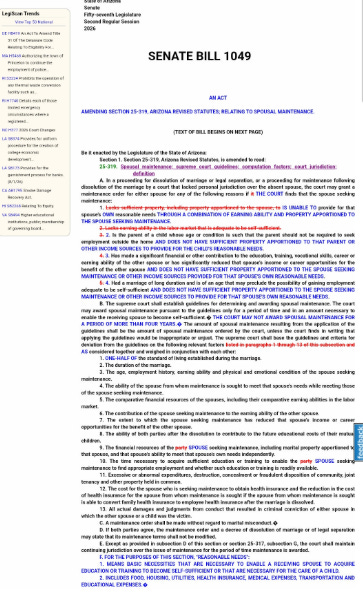
“The court may not award spousal maintenance for a period of more than four years,” the bill states.
State Senator Rogers received some blowback, after she was accused of doing a political favor for the Republican President of the State Senate, Warren Peterson.

Peterson is going through a divorce and critics argued that Rogers’ bill was designed to limit his alimony.
State Senator Peterson did not respond to an email for comment.
State Senator Rogers addressed details of the bill, the controversy, and more.
1) Explain what is happening with alimony in Arizona and why you felt it needed reform?
This was a constituent-requested technical cleanup bill involving Arizona’s spousal maintenance statutes. As Judiciary Chair, it’s my responsibility to review court-related issues and sponsor legislation when clarifications or improvements to the law are warranted.
2) What does limiting alimony to four years do and does the bill do anything else?
The goal was to provide greater clarity and predictability within Arizona’s spousal maintenance laws. More broadly, the bill was intended to address concerns raised about how the statute is applied and interpreted
3) There was some controversy with some suggesting that you were doing a favor for State Senator Warren Petersen. What was the controversy and how do you answer the allegation that this was a political favor?
That allegation is false. This was a constituent-requested technical cleanup bill dealing with family court statutes. As Judiciary Chair, it was entirely appropriate for me to sponsor legislation within my committee’s jurisdiction. The bill was considered on its merits, nothing more.
4) Limiting alimony reduces—if not eliminates—stay-at-home parents. Is that something you thought of and what would you say to the charge that limiting alimony to four years all but eliminates the stay-at-home parent?
I disagree with that premise. Stay-at-home parents make valuable contributions to their families, and nothing in this bill was intended to diminish that. The discussion was about statutory clarity and predictability, not the value of parenting choices.
5) Most of the family court bills were killed in the legislature. Is there still hope for transformative reform of family court?
Absolutely. Family court remains an area of significant public interest, and important reforms often take multiple years. The conversation is continuing, and I expect it will remain a focus moving forward.
Conclusion
If I ruled the world, alimony would be eliminated. I don’t think anyone should be responsible for another person’s lifestyle after they’re married.
That said, this would eliminate the stay-at-home parent. Hopefully, we’ll get more clarity on this bill’s effect on stay-at-home parents as it progresses through the legislature.
Update
After I published, State Senator Rogers provided me with additional comment on my question about stay at home parents, “This bill upholds stay-at-home parents. It recognizes that reentering the workforce takes time and specifically allows courts to consider factors like education, training, earning capacity, the length of the marriage, and the needs of children. Spousal maintenance should be a bridge to self-sufficiency, not a permanent arrangement. This bill promotes long-term self-sufficiency while providing a reasonable transition period, taking into account the individual circumstances of each family, and ensuring that no one is left without support.”


